TL;DR
- GoHighLevel marketing automation helps agencies run email, SMS, and ad campaigns from a single behavior-based system.
- Automation should react to lead behavior such as clicks, replies, bookings, and no-shows. Not simply run on fixed schedules.
- Agencies can automate the entire lead journey, from form submission and nurturing to booking, conversion, onboarding, and re-engagement.
- Effective campaign automation requires custom sequences, smart triggers, audience syncing, conversion-focused reporting, and ongoing optimization.
- Multi-channel workflows need to be carefully coordinated to avoid duplicate messages, conflicting campaigns, and poor customer experiences.
- For agencies, scalable automation means creating repeatable and tested workflows that can be deployed across multiple client accounts.
- The goal isn't to replace agency teams. It is to reduce repetitive work and free staff to focus on tasks that require human judgment.
- When choosing a GoHighLevel agency, look for custom-built workflows, behavior-based triggers, proper testing, performance data, and ongoing management.
At some point every agency owner hits the same wall. More clients than a year ago, not more hours in the day. The instinct is to hire another account manager, another VA to send follow-ups, someone to babysit ad campaigns. That fixes the symptom for about six months, until you're back at the same wall with a bigger payroll.
A gohighlevel marketing automation agency handles this differently. Instead of adding people to run more campaigns, it builds systems that run the campaigns without a person touching most of them. That's not theoretical, it's the actual mechanism behind agencies managing 30-plus clients with a team of five.
"Automation" Usually Means Something Smaller Than People Think
Say "marketing automation" to most agency owners and they picture a scheduled email blast. Set it, forget it, move on. That counts as automation in the loosest sense. It's not what separates a scaling agency from one that's stuck.
Real automation reacts to what a lead does, not just what day it is. A lead opens an email but doesn't click, different next step than someone who clicks but doesn't book. Someone books a call and no-shows. Automatically re-engaged instead of manually chased down by whoever happens to remember to check the calendar that week.
GoHighLevel runs on this kind of behavior-based logic, and that's a large part of why agencies built on it handle this many moving parts without a matching headcount increase.

How Email, SMS, and Ads Run Off the Same Trigger
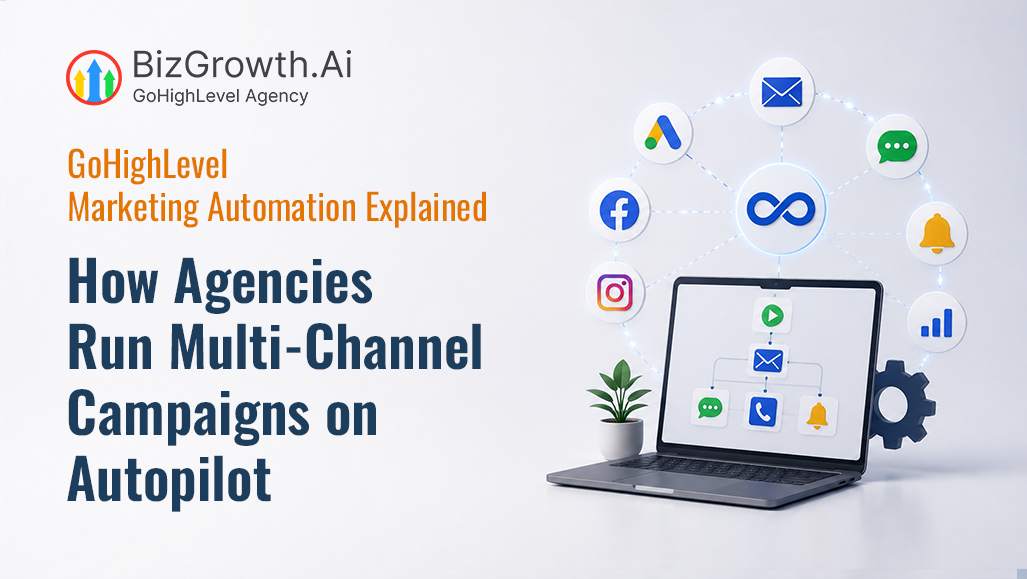
The time savings don't come from any single channel. They come from GoHighLevel running email, SMS, and ad retargeting off the same trigger, instead of three separate tools that don't talk to each other.
Roughly how it plays out on a client campaign: a lead fills out a form from an ad, gets an SMS within a minute, then an email sequence over the following days. If they don't convert, they land in a retargeting ad audience automatically. If they engage but stall out, a task gets created for a human to follow up personally. Once they book or convert, they drop out of the nurture sequence entirely and into whatever comes next onboarding, referral requests, a different list altogether.
Nobody's manually pulling a list and starting a new sequence at any of these steps. The trigger handles that. A person only steps in where actual judgment is needed, which turns out to be a small fraction of the leads moving through the system at any given time.
What a Real Campaign Setup and Management Service Involves
This is where agencies split into two camps. Anyone can turn on GoHighLevel's default templates. Building a gohighlevel campaign setup and management service that actually performs takes a lot more than flipping switches:
- Sequences written for the client's specific offer and audience, not pulled from a generic template
- Trigger logic based on real behavior opens, clicks, replies, bookings, no-shows
- Ad platforms connected so retargeting audiences update automatically instead of by hand
- Reporting that shows what's converting, not just what's sending
- Ongoing tuning based on what the data actually shows, not a launch-and-walk-away approach
Skip most of that and automation still technically runs. It just doesn't perform much better than doing nothing, because a badly tuned sequence sending the wrong message to the wrong segment is functionally the same as noise.
Coordinating Channels So They Don't Contradict Each Other
A gohighlevel multi channel marketing agency isn't running five disconnected campaigns and hoping they don't step on each other. The channels get coordinated around where the lead actually is.
Someone who just filled out a form shouldn't see a "still interested?" retargeting ad an hour later, that's premature and it looks sloppy. Someone who's gone cold for three weeks probably should. The sequencing between channels matters just as much as the content inside any one of them.
It's genuinely easy to build one automation. It's much harder to build fifteen that interact correctly, don't duplicate messages, and don't accidentally text someone six times in a day because two workflows fired at once. I've seen that exact thing happen from a poorly mapped trigger, and it's the fastest way to get a client asking why their leads are annoyed. Agencies that specialize in this catch that stuff before it goes live, mostly because they've already watched it break somewhere else first.
A common failure mode: a lead fills out a form for one campaign, then a separate re-engagement workflow picks them up a week later because nobody added an exclusion filter, and now the same person is getting two different offers from the same brand at the same time. Nobody designed that on purpose. It happens when workflows get built in isolation instead of mapped against everything else already running in the account. Fixing it after the fact means auditing every workflow touching that contact, which takes longer than building the exclusion logic correctly the first time would have.
Why the Stakes Are Higher for an Agency Than a Single Business
A business running one automated sequence for itself can get away with some rough edges. An agency running the same infrastructure across 20, 30, 50 client accounts doesn't have that room. A mistake in one workflow template gets copied into every account built off it, and a client whose leads just got double-texted notices immediately.
Scaling automated campaigns isn't "set up more workflows." It's building templates reliable enough to replicate across dozens of accounts without someone manually checking each one for mistakes. Agencies that do this well tend to have their own internal system for building, testing, and rolling out new workflows before they touch a live client account, treating their own automation setup like a product, not a one-off project done fresh each time.
What Good Automation Buys You
Less manual follow-up. Fewer leads falling through cracks because nobody remembered to check on them. Campaigns that run the same on a Saturday as a Tuesday. And for an agency owner specifically, the ability to take on more clients without a 1-to-1 increase in staff.
Automation done right isn't about replacing your team. It's about freeing up their time for the calls and conversations that actually need a person, instead of the repetitive follow-up a workflow could've handled hours earlier without anyone noticing.
Choosing an Agency to Build This
Not every agency selling GoHighLevel setup is actually building real automation. Some turn on default templates and call it done, which technically counts as "automation" without moving much of anything.
Worth asking before hiring anyone:
- Are sequences built around the client's specific offer, or pulled from a generic template?
- Is trigger logic based on actual lead behavior, or just a fixed time delay?
- Do they build and test workflows before pushing them live, or is your account the test?
- Can they show real performance data from other clients, not just dashboard screenshots?
If you're looking to scale campaign management without scaling headcount, HireHighLevelAgency builds and manages the full multi-channel setup email, SMS, ads, and the trigger logic connecting them. So, campaigns keep running whether or not anyone's watching.