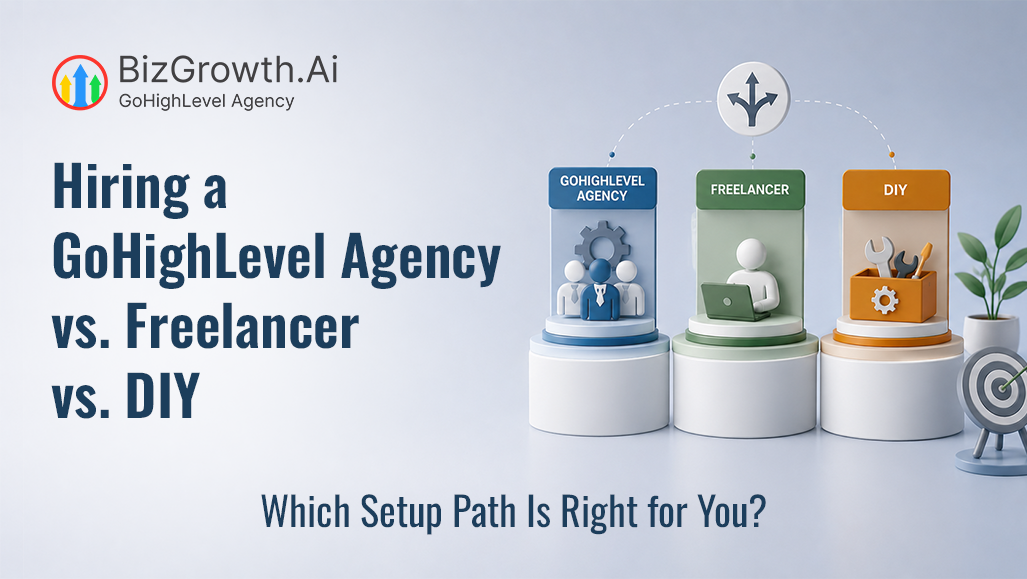
TL;DR
Choosing between DIY, a freelancer, and a GoHighLevel agency comes down to your budget, technical needs, time, and growth plans. DIY offers the lowest upfront cost but requires significant time and comes with a higher risk of mistakes. A freelancer is a good choice for smaller, well-defined projects or specific fixes. A professional GoHighLevel agency costs more upfront but provides strategic setup, advanced automation, faster implementation, ongoing support, and better scalability.
Introduction
Choosing the right way to set up GoHighLevel is one of the most important decisions your business will make this year. Your CRM, automations, funnels, and integrations all depend on a foundation that works correctly from day one- get that wrong, and it costs you leads, time, and money down the line.
Business owners generally weigh three paths: building it themselves, hiring a freelancer, or working with a professional GoHighLevel agency. Each comes with real trade-offs in cost, speed, and risk. This guide breaks down all three honestly, so you can decide with confidence which setup approach fits your business.
Why Your GoHighLevel Setup Is Critical for Business Growth?
Your GoHighLevel setup is often the first system your leads interact with- a booking calendar, an automated follow-up or a funnel page. First impressions matter, and a clunky experience can cost you the sale before a conversation even starts.
A poor setup leads directly to missed opportunities: leads slipping through the cracks, automations that never fire, pipelines that don't reflect how your business sells. Because your CRM, automation, pipelines, calendars, and campaigns all rely on each other, one weak piece can quietly break the whole system. Investing in the right setup saves significant time and money later, regardless of which path you take to get there.
Option 1- DIY GoHighLevel Setup
Who Is DIY Best For?
- Beginners with extra time on their hands
- Small startups operating on a tight budget
- Users comfortable learning through trial and error
Pros
- Lowest upfront cost- you're only paying for your GoHighLevel subscription
- Learn the platform yourself, building internal knowledge over time
- Full control over every workflow, automation, and setting
Cons
- Steep learning curve- GoHighLevel is powerful, but its depth means beginners often spend weeks figuring out what a professional could configure in hours
- Time-consuming- every hour spent learning the platform is an hour not spent serving clients or growing revenue
- Higher chance of mistakes- misconfigured triggers, broken automations, and disorganized pipelines are extremely common in DIY builds
- Lost productivity- business owners routinely underestimate how much time a proper setup demands
- Limited optimization- even a "working" DIY setup rarely reflects best practices, so performance gets left on the table
DIY can work for simple use cases or business owners with genuine spare time. But if you're short on time and comparing your options, it's usually the slowest and riskiest path- not necessarily the cheapest once your own time is factored in.
Option 2- Hiring a GoHighLevel Freelancer
Who Should Hire a Freelancer?
- Businesses needing help with a single, well-defined project
- Small customizations to an existing setup
- Short-term or one-off requirements rather than a full build
Pros
- More affordable than working with a full agency
- Flexible hiring- easy to bring someone on quickly for a narrow task
- Specialized skills for specific technical fixes or builds
Cons
- Skill levels vary significantly- there's no consistent vetting standard across freelance platforms, so quality is a gamble from one hire to the next
- Limited support after project completion- many freelancers move on once paid, leaving you stuck if something breaks later
- Communication delays, especially with freelancers juggling multiple clients or working across time zones
This is really the core of the GoHighLevel vs hiring freelancer setup debate: freelancers make sense for small, contained jobs- fixing one automation, building a single funnel- but they're a weaker fit for a full system meant to scale with your business.
Option 3- Hire a GoHighLevel Agency
Who Is It Best For?
- Growing businesses
- Marketing agencies
- Coaches and consultants
- Service-based businesses
- Businesses scaling through automation
Pros
- Proven frameworks and snapshots that mean a faster launch with fewer mistakes
- Strategic guidance, not just technical execution- the build is shaped around your business goals, not just a feature checklist
- Ongoing support, accountability, and scalability as your needs grow
- Experience across many businesses and niches, meaning fewer blind spots and faster troubleshooting
- Team backup- you're never dependent on one person's availability or expertise
Cons
- A higher upfront investment but one that reflects the strategy, support, and long-term reliability built into the setup, not just the build itself
- Choosing the right agency takes a little research a few minutes of due diligence upfront (checking reviews, past work, or case studies) ensures you're paired with a team that's the right fit for your business
This is where the value of a professional GoHighLevel setup really shows: fewer broken automations, a CRM structured for how your business actually operates, and a partner still available if something needs adjusting six months from now something neither DIY nor freelance work reliably offers.
GoHighLevel Agency vs Freelancer vs DIY
| Feature | DIY | Freelancer | GoHighLevel Agency |
|---|---|---|---|
| Initial Cost | Low | Medium | Higher |
| Learning Curve | High | Low | None |
| Setup Speed | Slow | Medium | Fast |
| Strategy Included | ❌ | Sometimes | ✅ |
| Long-Term Support | ❌ | Limited | ✅ |
| CRM Optimization | Basic | Moderate | Advanced |
| Funnel Expertise | Limited | Good | Expert |
| Automation Quality | Basic | Good | Advanced |
| Team Support | ❌ | ❌ | ✅ |
| Scalability | Limited | Moderate | Excellent |
Cost Comparison- Which Option Offers Better Value?
DIY
- Lowest upfront investment of the three
- Highest time investment- often weeks of learning and trial-and-error before the system is fully functional
Freelancer
- Moderate pricing, generally lower than an agency
- Best suited to limited, well-scoped projects rather than a full business system
Agency
- Higher initial investment than DIY or freelance
- Lower long-term costs, since fewer errors mean less rework
- Better business outcomes from strategic, experience-driven setup
- Reduced operational risk through ongoing support and proactive maintenance
It's tempting to choose whichever option looks cheapest on paper. But the real cost of any setup isn't just the invoice- it's your time, the mistakes that need fixing, and the leads lost while a system underperforms. Once you factor those in, an agency's build often works out more economical over a 6 to 12-month window, even though the upfront number is higher.
Common Mistakes Businesses Make When Choosing the Cheapest Option
Choosing the lowest-cost path without considering the full picture tends to create the same recurring problems:
- Ignoring automation planning- building workflows without mapping the customer journey first, leaving gaps and dead ends
- Poor CRM structure- disorganized pipelines and contact fields that get harder to fix the longer they're left alone
- Broken workflows- automations that fail silently, so follow-ups simply never happen and no one notices until leads are already lost
- Weak lead nurturing- sequences too generic or poorly timed, letting warm leads go cold
- No documentation- setups built without notes or structure, making future changes difficult for anyone, including the business owner
- Lack of future scalability- systems built for today's needs that require a full rebuild the moment the business grows
These mistakes show up across both DIY and freelance builds, largely because both paths tend to prioritize getting something working over getting something built to last. It's one of the clearest reasons growing businesses eventually move to a more experienced setup partner.
When Should You Hire a Professional GoHighLevel Agency?
Not every business needs an agency on day one, but there are clear signals that it's time to bring in professional help. Consider it if:
- You're launching a new business and want to start on a strong, reliable foundation instead of fixing problems later
- You need everything set up correctly the first time, with no room for costly trial and error
- Your team lacks GoHighLevel expertise, and the learning curve would pull focus from higher-value work
- You want advanced automations- multi-step nurture sequences, conditional logic, integrations beyond a basic build
- You're migrating from another CRM and need the transition handled carefully so data and existing workflows aren't lost
- You need ongoing technical support, not just a one-time build, so issues get resolved as they come up
- You're managing multiple client accounts, where consistency and scalability matter as much as the initial setup itself
If two or more of these apply, the case to bring in an agency gets fairly strong. The cost is usually offset- often quickly- by the time saved, the mistakes avoided, and the improved performance of a system built by people who do this daily. Businesses that wait until after a DIY or freelance setup has already caused problems tend to pay twice: once for the original build, and again to have it properly fixed.

Which Setup Path Is Right for You?
There's no universally "right" answer, but there is a right one for your situation. Ask yourself:
- How much is your time worth per hour? If a DIY build takes 40+ hours, what does that actually cost your business in lost focus or revenue?
- How complex is your use case? A single simple funnel is a very different project from a full CRM overhaul with multiple automations and integrations.
- Do you need ongoing support, or just a one-time build? DIY and freelance work rarely comes with support once it's done.
- What's your risk tolerance for downtime or errors? A broken follow-up automation isn't just annoying- it can mean real, measurable lost revenue.
If your answers point toward limited spare time, a system that needs to scale, and low tolerance for costly mistakes, working with an experienced partner is generally the safer, more efficient path. If your needs are simple and contained, and you have time to spare, DIY or a freelancer may be enough for now.
The Conclusion
Each path- DIY, freelancer, or agency- comes with its own trade-offs in cost, speed, and risk. The right choice depends on your goals, budget, and growth plans. For businesses that want a reliable system built right the first time, choosing to hire gohighlevel agency remains the clearest route to a professional GoHighLevel setup, fewer costly mistakes, and stronger long-term ROI.
Frequently Asked Questions
Is hiring a GoHighLevel agency worth it?
For most growing businesses, yes. It reduces setup time, avoids the mistakes common in DIY and freelance builds, and adds ongoing strategic guidance that a one-time project doesn't include.
What's the difference between a freelancer and a GoHighLevel agency?
A freelancer is typically hired to execute one defined task with little support afterward. An agency offers full-service setup, strategic planning, and continued support backed by a team- a better fit for businesses that need reliability and scalability rather than a single fix.
How much does a professional GoHighLevel setup cost?
Pricing depends on the complexity of the automations, funnels, and integrations involved. Agencies typically charge more upfront than freelancers or DIY, reflecting a faster launch, fewer errors, and stronger long-term performance.
How long does a GoHighLevel agency take to complete a setup?
Agencies generally move faster than DIY or freelance timelines, thanks to proven frameworks, prebuilt snapshots, and day-to-day experience with the platform.
Is GoHighLevel difficult to set up without professional help?
It's possible on your own, but the learning curve is steep. Many DIY users run into broken automations or poorly structured pipelines that go unnoticed until they've already cost the business leads.